 Skip to main content
Why Businesses Are Suddenly Questioning Their SEO After Running AI Audits
Over the last few months, we’ve seen a major increase in real estate investor (REI) businesses running AI-generated SEO audits on their websites and then coming back concerned that critical SEO work is missing.
Spread the Knowledge
At Bateman Collective, we work specifically within the REI industry, so we’ve seen firsthand how these audits are starting to create confusion for investors, wholesalers, and cash home buyers trying to understand whether their SEO campaign is actually moving in the right direction.
Honestly, we understand why.
Some of these audits are long, detailed, and sound extremely convincing. They flag everything from internal linking and schema to AI visibility, topical authority, page structure, local SEO gaps, and conversion concerns. When a business owner sees a report listing 20 or 30 “issues,” it can quickly feel like the campaign is off track.
The problem is that many of these audits are evaluating the website without understanding the actual strategy behind it.
That’s the disconnect.
In a lot of cases, the AI is identifying real SEO concepts, but completely missing the operational context, implementation sequencing, campaign maturity, and long-term roadmap already in place.
That is what this article is meant to explain.
“AI audits can identify opportunities, but they cannot replace strategic prioritization, operational SEO systems, and long-term execution.”

Zach Blackburn
SEO Director, Bateman Collective
Here’s Where AI SEO Audits Start Falling Apart
AI audits are very good at spotting patterns. They can quickly identify visible SEO opportunities and technical concerns across a website.
That part is useful.
Most audits will flag things like:
- weak internal linking
- missing schema
- limited topical authority
- local SEO gaps
- thin content
- poor heading structure
- AI visibility concerns
- page speed or crawlability issues
The issue is not that these concepts are wrong.
The issue is that AI audits often treat websites like finished products instead of active SEO campaigns.
Real SEO campaigns evolve over time. They move through phases. They prioritize certain work before others. They adjust based on performance data, technical limitations, competition, conversion quality, and campaign maturity.
That’s where AI audits usually lose context.
For example, an audit may say:
“This website lacks enough schema markup.”
Technically, that may be true.
But what the audit cannot see is:
- FAQ sections currently being built
- location pages still being finalized
- internal linking updates already planned
- technical cleanup is currently taking priority
- schema implementation already scheduled for a later phase
That context changes the meaning completely.
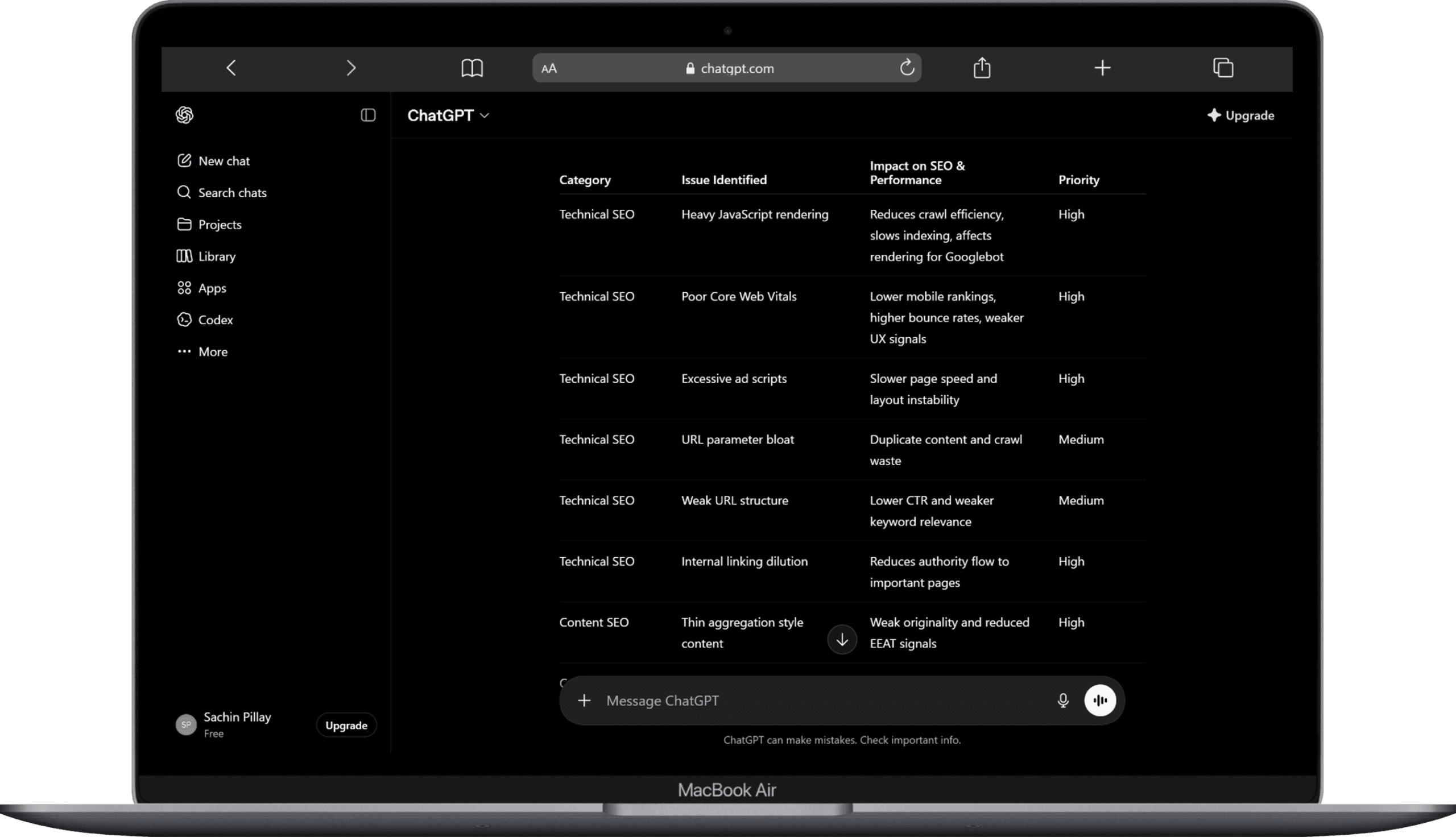
Example of the type of AI-generated SEO audit businesses are now receiving (Website used is https://www.msn.com/)
What Most AI Audits Cannot Actually See?
One of the biggest limitations of AI-generated SEO audits is that they evaluate a snapshot of the website at a single moment in time.
What they usually cannot fully see:
- completed work behind the scenes
- phased implementation schedules
- campaign maturity
- future roadmap execution
- conversion optimization testing
- reporting analysis and adjustments
- operational workflows
- authority-building campaigns
- client-specific goals and priorities
A real campaign is constantly balancing:
- technical priorities
- content expansion
- local SEO
- authority building
- CRO improvements
- AI visibility refinement
- reporting data
- implementation resources
What A Real REI SEO Roadmap Looks Like At Bateman Collective
One thing we see AI audits miss all the time is how SEO actually gets rolled out in the real world.
At Bateman Collective, we don’t approach REI SEO by trying to cram every strategy into the first month of a campaign. That usually leads to messy implementation, weaker content, and a strategy that becomes difficult to scale properly later on. Most campaigns start with foundational work first.
Things like technical cleanup, metadata improvements, indexing issues, page structure, and core content optimization. Once that foundation is solid, we start expanding into deeper content, internal linking, authority building, schema, AI visibility improvements, and conversion refinements.
That’s how most successful REI SEO campaigns grow over time. Not by doing everything at once, but by building the right pieces in the right order.
Foundation
Content
Internal Linking
Authority
CRO
AI Visibility
1. A typical campaign often starts with foundational work, such as:
- crawlability
- indexing
- metadata optimization
- technical audits
- heading structure fixes
- page speed improvements
- tracking setup
- Search Console analysis
2. Once the foundation is stable, campaigns usually expand into content and relevance.
- key page refreshes
- location page optimization
- seller situation pages
- FAQ development
- topical authority expansion
- underperforming page optimization
3. As the campaign matures further, strategies often expand into:
- internal linking refinement
- schema implementation
- authority building
- backlink outreach
- CRO improvements
- trust signal optimization
- AI visibility refinement
This is why AI audits can sometimes make good campaigns look incomplete.
The audit may identify something that is “missing,” while completely failing to understand that the campaign simply has not reached that phase yet.
Let’s Break Down Some Real AI Audit Claims
AI Audit Says: “The Website Has Weak Internal Linking”
We see this one constantly.
And to be fair, internal linking is important. It helps search engines crawl the site, distribute authority, connect related topics, and improve user navigation.
But here’s where AI audits oversimplify the issue:
Internal linking is not a one-time task.
It evolves as the website grows.
Internal linking usually changes when:
- new location pages are launched
- FAQ sections are added
- topical clusters expand
- seller situation pages are created
- new conversion pages go live
That means internal linking is continuously refined as the strategy develops.
So yes, AI may correctly identify weak internal linking.
What it often misses is whether those improvements are already part of the roadmap and dependent on other work happening first.
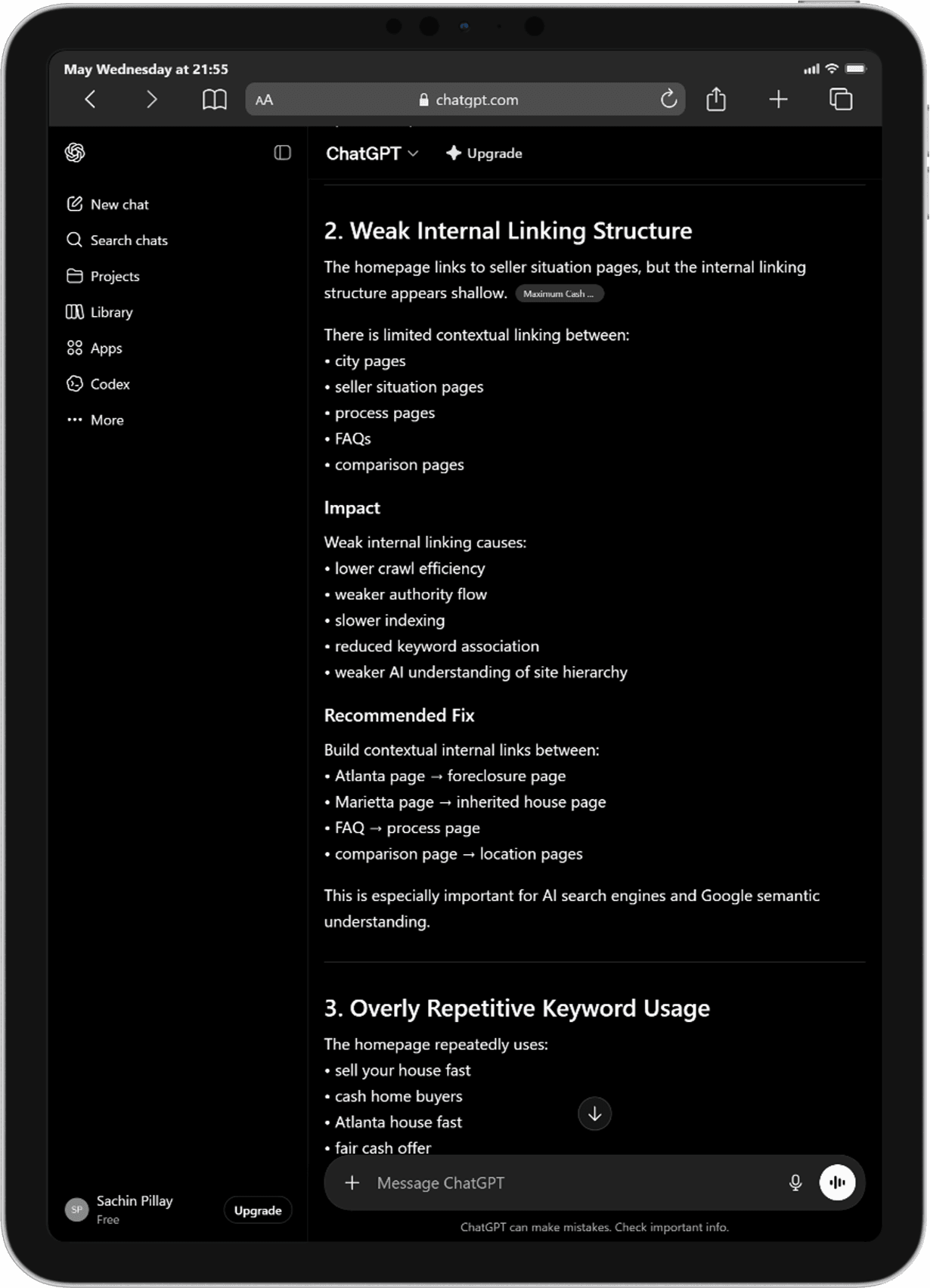
What The Audit Is Missing
Internal linking improvements often depend on content expansion already scheduled within the campaign.
You cannot fully optimize internal linking for REI websites when the supporting motivated seller pages, city pages, and FAQ content have not been built yet.
At Bateman Collective, internal linking usually evolves alongside content expansion because the strategy depends on connecting related seller situations, local markets, and conversion-focused pages together over time.
1. AI Audit Says: “The Website Lacks Topical Authority”
This is another extremely common one.
AI audits often say websites lack topical authority when there are not enough supporting pages around important topics.
And honestly, the concept itself is correct.
Topical authority absolutely matters.
But topical authority is not built all at once.
A strong topical authority strategy is usually layered over time through:
- supporting content
- FAQ expansion
- internal linking
- location relevance
- schema
- semantic refinement
- Search Console optimization
If all of that gets rushed too quickly, websites often end up with:
- repetitive pages
- thin content
- poor user experience
That can actually hurt performance instead of helping it.
This is why many campaigns intentionally build topical authority progressively instead of trying to launch everything immediately.
2. AI Audit Says: “The Website Needs More Location Pages”
This one comes up constantly in local SEO campaigns.
And again, there’s truth behind it.
Local relevance matters.
But AI audits usually do not understand the operational risk of scaling location pages too aggressively.
A strong location page needs more than just swapping city names into a template.
Good location pages usually require:
- unique localized content
- clear search intent
- trust signals
- conversion elements
- supporting FAQs
- schema
- strong internal linking
A lot of AI audits simply assume:
“More pages = better SEO.”
That’s not always true.
We’ve seen websites launch hundreds of low-quality location pages that end up diluting the site instead of strengthening it.
That’s why many SEO campaigns expand location coverage in phases instead of trying to launch everything immediately.
3. AI Audit Says: “The Website Has Weak AI Visibility”
This is becoming much more common.
AI audits now regularly mention:
- AI visibility
- semantic SEO
- conversational content
- entity optimization
- AI citations
- structured information
And yes, these things matter.
But AI visibility is not some separate magical SEO system.
Strong AI visibility usually comes from strengthening the same foundations that already matter in traditional SEO:
- clear content structure
- internal linking
- schema
- authority
- topical depth
- semantic relevance
- crawlability
This is exactly how we approach AI visibility optimization at Bateman Collective for REI businesses.
Instead of treating AI visibility like a separate trend, we build it naturally into the strategy, layered into the campaign over time.
AI visibility optimization often includes:
- FAQ expansion
- conversational search targeting
- semantic refinement
- stronger heading structures
- entity relationship improvements
- schema implementation
The key thing most audits miss is timing.
Not every campaign is at the AI visibility refinement stage yet.
4. AI Audit Says: “The Website Is Over-Optimized”
This is one of the more interesting ones we’ve seen lately.
In one audit example, AI flagged keyword over-optimization because a website repeatedly used phrases like:
- “sell your house fast”
- “cash offer”
- “we buy houses”
Now obviously, keyword stuffing is bad.
But context matters.
In highly competitive lead generation industries, certain phrases naturally appear more often because they directly match:
- real search behavior
- buyer language
- local search intent
- conversion intent
This is where understanding the REI industry becomes extremely important.
Real estate investor websites naturally use phrases like “sell your house fast” or “cash offer” more frequently because that’s how motivated sellers actually search. The goal is not to remove those phrases entirely. The goal is to use them naturally while still building content depth, trust, and topical relevance around them.
A generalized AI audit may treat repeated industry phrases as over-optimization even when the language is aligned with how real people actually search.
That doesn’t mean content should sound robotic.
It just means context matters more than broad AI assumptions.
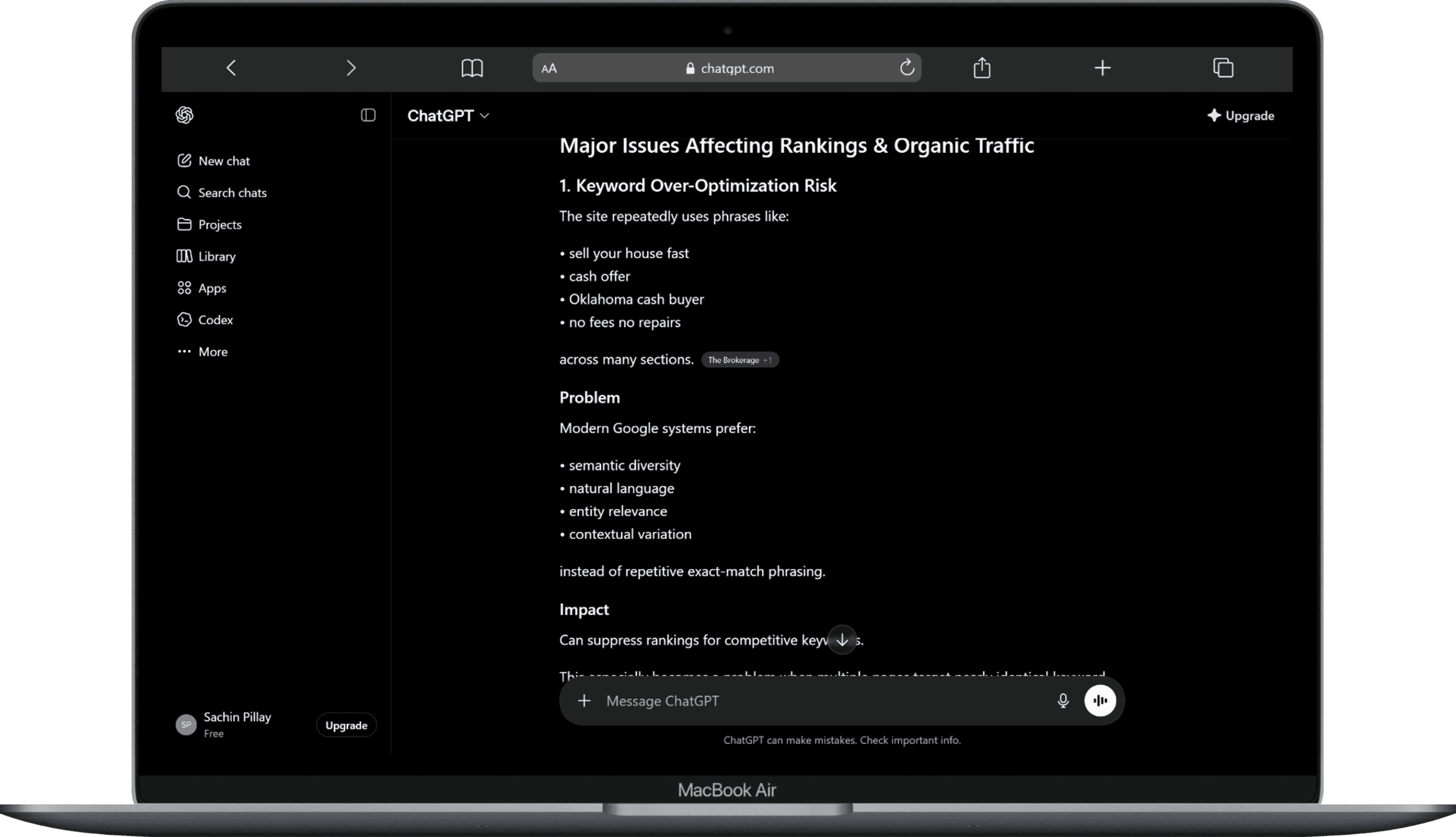
The Bigger Issue: AI Creates Urgency Without Prioritization
This is probably the biggest problem overall.
Most AI audits present every issue with roughly the same level of urgency.
That’s not how SEO works.
Not every issue deserves immediate attention.
For example:
- Indexing issues are usually more urgent than missing alt text
- Crawlability problems usually matter more than advanced schema refinement
- Weak conversion pages may matter more than publishing new blog
- Authority building may depend on stronger content foundations first
This is why strategic prioritization matters so much.
Good SEO is not just about finding problems.
Good SEO is about:
- knowing what matters most
- understanding implementation dependencies
- balancing short-term wins with long term growth
- sequencing work correctly
- improving the areas that actually move performance
That’s the part AI still struggles with heavily.
“Just because AI identifies something as missing does not mean it is being ignored. In many cases, it is already part of the strategy, but it needs to happen at the right stage.”
Zach Blackburn
SEO Director, Bateman Collective
So What Should Businesses Actually Do With An AI Audit?
A long audit does not automatically mean the campaign is failing.
Others may:
- already be planned
- already be in progress
- be lower priority
- depend on future implementation stages
- lack proper business context
The best thing businesses can do is review AI audits through the lens of the actual SEO roadmap.
Questions businesses should ask:
- Is this issue genuinely impacting rankings or conversions?
- Is this already included in the strategy?
- Is this urgent or phased?
- Does this recommendation make sense for the niche?
- Would fixing this now create more impact than current priorities?
That is the difference between reacting emotionally to an audit and using it strategically.
AI Audits Are Useful. They’re Just Not The Strategy.
AI audits are not useless. In fact, they can be extremely helpful when interpreted correctly.
For example:
- surface opportunities
- identify visible gaps
- generate useful discussion points
- highlight technical concerns
- help businesses ask better questions
But they are still pattern recognition systems. They are not campaign management systems.
They do not know:
- the roadmap
- the client history
- completed work
- implementation sequencing
- operational workflows
- reporting analysis
- broader business goals
That human layer still matters heavily.
Especially in long term SEO campaigns, where strategy, prioritization, timing, and operational execution are what actually drive sustainable growth.
“AI is a tool. It can help surface opportunities, but the strategy still needs to be reviewed through real campaign data, client context, and human expertise.”
Zach Blackburn
SEO Director, Bateman Collective
Why Strategy Still Matters
What businesses need to remember is that an SEO audit only shows part of the picture.
A website might genuinely have areas that still need work, but that does not automatically mean the campaign is failing or that the SEO team is missing things. In most long-term REI campaigns, there’s usually a roadmap behind the scenes that the audit simply cannot see.
At Bateman Collective, a lot of the work we do is phased intentionally. Some improvements make sense early on. Others only become effective once the site has stronger content, better structure, or more authority behind it.
In the REI industry specifically, SEO usually involves balancing things like:
- technical fixes
- location page expansion
- motivated seller content
- internal linking
- Google Business Profile growth
- authority building
- conversion improvements
- AI visibility refinement
Trying to force all of that into the beginning of a campaign usually creates rushed work and weaker long-term results.
That’s also why two websites in the same industry can have completely different SEO priorities. One investor may need stronger local relevance. Another may have technical issues holding rankings back. Another may already rank well but struggle with conversions.
AI audits can absolutely be useful, and honestly, they’re becoming part of the industry now. They can help surface opportunities and start important conversations. But they still need to be reviewed with a real campaign context behind them.
If you’ve run an AI SEO audit on your REI website and you’re unsure which recommendations actually matter right now versus what may already be planned into the roadmap, feel free to reach out to Bateman Collective. We’re always happy to review the bigger picture, not just the audit itself.
